$ (USD)
English


Barcelona can really be considered a tourist paradise. Everything's there: from the sea and sandy beaches to the magnificent gardens and the works of Gaudi. Aside from Spanish Art Nouveau, you'll also find Gothic, Moorish, and Neoclassical buildings. The Mediterranean cuisine with fresh seafood plus Catalan wine and culture will make Barcelona a big deal.
You'll want to come back again and again. And with tours to Spain to do it will be much easier.
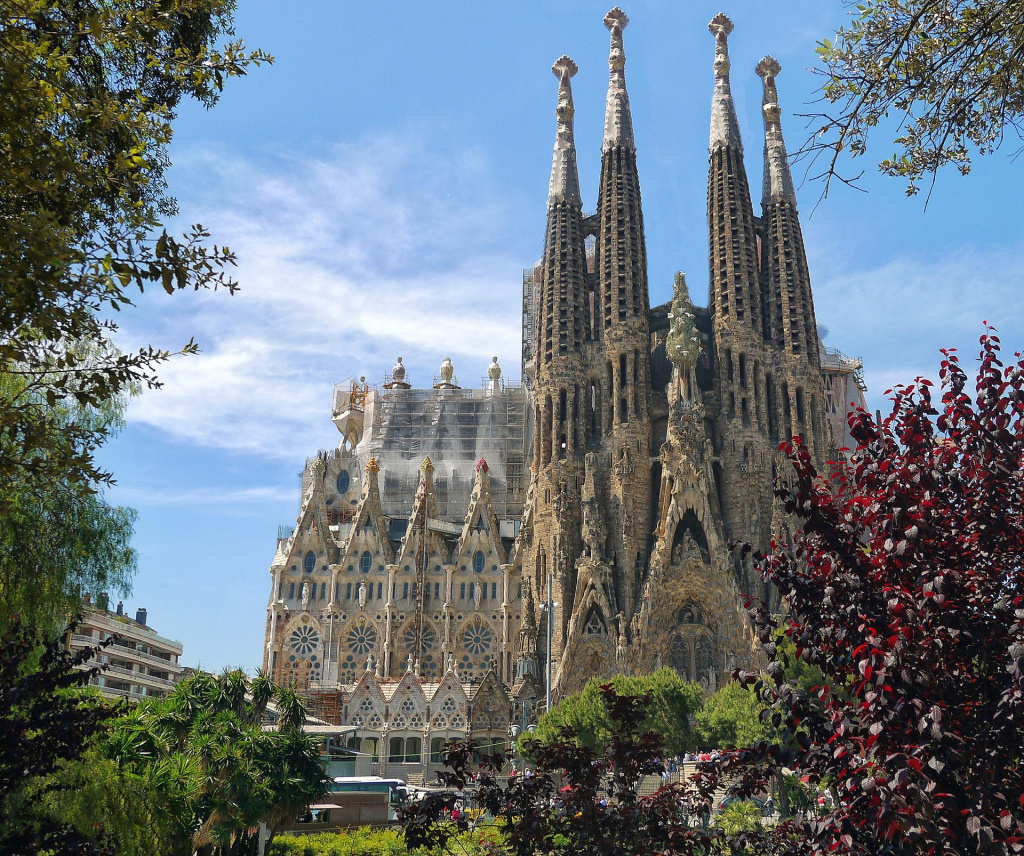
Barcelona's symbol is Gaudi's Sagrada Familia. In addition to these, Casa Batlló, Casa Milo, and Park Güell stand modestly. The city's charm doesn't end there: the Gothic Quarter with its Plaza Royale, the Ramblas, the Citadella Park, and the Columbus monument are all in the running for major city landmark status. You can also check out the large Botanical Gardens, Gracia Avenue, or Bogatell Beach.
Opus Magnum by Gaudi is a symbol of the city, and it's probably the most amazing working Catholic temple in the world. It's still being built with donations. Expiatory Temple of the Holy Family is its full name. A few kilometers from Barcelona, in the Eixample, construction began in 1882. Gaudi said he was inspired by the idea of a sun-drenched forest. In the cathedral, this is done with columns mimicking natural forms and tall stained-glass windows.
In the second half of the twentieth century, after the death of the architect, the Nativity and Passion facades went up. At the moment, the Glory facade is going up. The grandiose structure's gonna be done by 2026. In general, it fits in well with the centuries-old tradition of Gothic cathedral building. The Sagrada Familia cathedral is a child of the Art Nouveau style. You can get here easily because the temple is near the metro station of the same name.
A visit to Barcelona without seeing the Gothic Quarter is quite strange, to say the least. Middle Ages aren't the earliest era represented by the buildings here. You can also see stuff from the Roman Empire. Beautiful architecture, narrow streets, lots of cafes, restaurants, and boutiques. It's got a touch of the ancient.
Laietana Street and the legendary Boulevard Rambla encircle the block. You should check it out during daylight hours. You'll need comfortable shoes for the paving stones.
It's fun to stroll along Barcelona's promenade in any season. Once you're done with the Rambla, you can keep walking along the promenade. About 30 years old, it's filled with sculptures, including floating ones. You can shop and take a boat ride for 7-20 euros. There's also an aquarium nearby.
It is located in the Gothic Quarter, as its name suggests. Drassanes metro station is very close by. There's a great view from Columbus Monument. What can you do in the port? Watch the sunset over the sea while eating tapas, drinking wine, and sipping sangria. There are lots of boutiques and shops here, and there is a yacht anchorage.

There's no village called Poble Espanyol, it's a museum in Barcelona. There's the magical fountain of Montjuic just a few steps from Espanya station. The open-air museum was built in the 1990s. You'll get a feel for what life was like for the Catalans and the Spaniards back then. There are tons of souvenirs to look at and buy, and you can even book a table in a cafe in advance and get a discount.
There's something interesting about knowing that one of Barcelona's main attractions was created by a commercial failure. We're talking about Parc Guell, a supposed garden city. But it didn't work out, and one of the houses built in the park was bought by the architect himself. It's Antonio Gaudi, of course.
Colonnades, tunnels, and even benches were designed by the Catalan genius. This park was built from 1900 to 1914. Talk about it a lot, but you should go see it. Also, don't miss the Gaudi house museum.
Over 17 hectares, there's a paid zone and a free zone. There's a metro station dedicated to King Alfonso X the Wise where you should get off. There's a special bus that goes to the park. A ticket for an adult costs 10 euros, and a ticket for a kid costs 7 euros. Best to go in sunny weather so the ceramics sparkle.
San Pau, Hospital de la Santa Creu i Sant Pau, is a big hospital complex. Built by Llu*s Domènech i Montaner, it's one of the best examples of modernist architecture in the city. Although the hospital on the site dates back to the fifteenth century, the building only dates back to the twentieth century. The station at Sant Pau is the easiest way to get there.
The local temple is worth checking out. A few cafes and restaurants are nearby. The route can be built from Sagrada Familia, with the entrance costing about 15 euros. It has stained glass windows and underground tunnels.
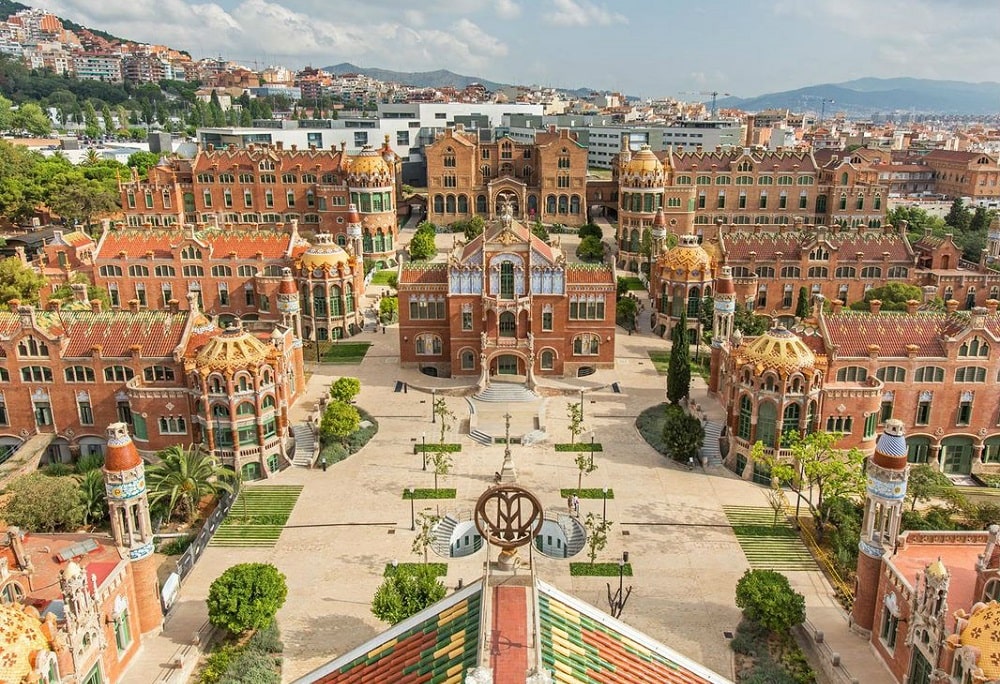
Photo: barcelona24.ru
If you want to learn more about marine life, head to the Old Port. There are metro stations nearby, like Barceloneta and Drassanes. We're talking about the Aquarium of Barcelona, so no diving required. It's worth a visit since it's Europe's biggest aquarium.
Slowly, the people of the Mediterranean Sea will swim behind the glass. It's a huge tunnel – 80 meters long. Diverse ecosystems are on display: underwater grottoes, caves, and thickets of algae. There are also fish from all over, not just the Caribbean and the Red Sea. They have 11000 animals, including 300 fish. There's also a shopping mall and an exhibition. Prices are around 15-20 euros.
The magic fountain of Montjuïc or Font màgica de Montjuïc can be accessed by climbing the mountain of the same name. The building looks futuristic at the time of its construction – 1929. It became a musical fountain in 1992, and it's been remodeled since.
Machines control the schedule of the fountain and all processes. From the port you can take the cable car up the mountain or take the subway. The Park Montjuïc is nearby.
«New field» is the literal translation of the stadium's name. Cafes and bars are here, but you have to walk to get there. Take the metro to Collblanc or Palau Reial. Fans of FC Barcelona can't just come to this city and not see this stadium. You'll learn about the history of the club and the stadium if you go. You can buy souvenirs too. Online tickets are a little cheaper.

It's impossible not to think of the Boqueria when you hear the word «market» in Barcelona. By the famous Ramblas is the Mercat de la Boqueria. From the metro station Liceu you can get to the market. Wine, jamon, fresh fruits and veggies, and seafood are the main hauls.
You can also get cooked takeout and bars. There's been a market here since 1840, and it's 2.5 square kilometers of fresh produce. Our recommendation is to try sliced fruit, but whole foods are cheaper than their supermarket counterparts.
You can walk from the Arc de Triomf metro station to the zoo, which is located in the Parc de la Citadella. The park is home to more than 300 species of animals and 400 species of plants. It's easy to get around the zoo on a special streetcar. Zoo was founded in 1892 and already had a reputation for innovation.
Visitors weren't separated by metal fences, but by water barriers. It was here not so long ago that there was an albino gorilla, and the zoo does a lot of work studying them. There's a terrarium where you can see Komodo varanas up close. If you want to see all the animals, like giraffes and elephants, you should go during the summer.
Don't look for a medieval donjon tower called Torre Agbar. There's a modern skyscraper with rounded shapes instead. It's owned by the Agbar Group. It's also home to Aguas de Barcelona, which provides fresh water in Barcelona. There are 38 floors in the Rainbow Tower, but it's not even among Spain's ten tallest buildings. The architect is Jean Nouvel, and the builders are Dragados. Diagonal Avenue has the tower, and at night you can see it best when it's lit up.
The Castle of the Three Dragons, or Castle of Tres Dragons, isn't medieval at all, despite its name. Built for the same World's Fair as the nearby Arc de Triomphe, it was built in the late 19th century. At the time, a novel by Serafi Petarra was popular, so the name probably came from that. Located in the Parc de la Ciutadella, the Art Nouveau building now houses the zoological museum. You can walk from the metro station Arc de Triomf. By the way, there used to be a cafe in the building.

In Rue Montcada, you'll find the Palau Dalmases, one of the nobility's residences since the Middle Ages. You can walk there from the Jaume I metro station. Flamenco can be found in different parts of the city and at various events, but it's the Palau Dalmases where it really shines.
The baroque mansion dance transports us to a bygone era. Show starts at a certain time, which can vary depending on the day. Filming isn't allowed. 15 euro for children, 30 euro for adults. Each adult gets an additional drink at the bar. The Picasso Museum and several cafes are nearby.
It's the Mediterranean. Barcelonetta is right over the sea and is where most of the city's beaches are. In case you don't like one of the beaches, you can walk to another or take the bus that runs along the seafront. You won't find any private beaches here, all are city-owned.
Sea water is almost always clear, and the mud is usually caused by storms undermining the sewage system. If the beach is closed, you shouldn't swim. It's best to avoid stinging jellyfish in the water in autumn. The reddened area can be soothed by pouring seawater or lemon juice on it. It's a good idea not to swim right after a storm.
If you want to have lunch or dinner at a decent price, stay away from beach cafes and restaurants. Also, locals recommend not stopping at the first cafe you see, and walking around and making a choice. Many places have menus in Russian. Fresh seafood and reasonable prices are found deep in Barceloneta, not on the beach.
You can get takeaway food and booze on the beaches. A large bottle of sangria may not be more expensive than a glass of the same drink. On the beaches, you can rent umbrellas and sun loungers, but you can get them for cheaper at the supermarkets nearby. Barcelona has sandy beaches. There aren't any changing rooms.
Barcelona's most famous beach is Barceloneta. It's surrounded by skyscrapers. There's a cafe here, or you can eat food you brought with you, like from the city market. Old Port or Port Vell is where the beach is. Get there from the Columbus Column. Barcelonette is right next to residential areas, so it's not a good idea to leave stuff unattended.
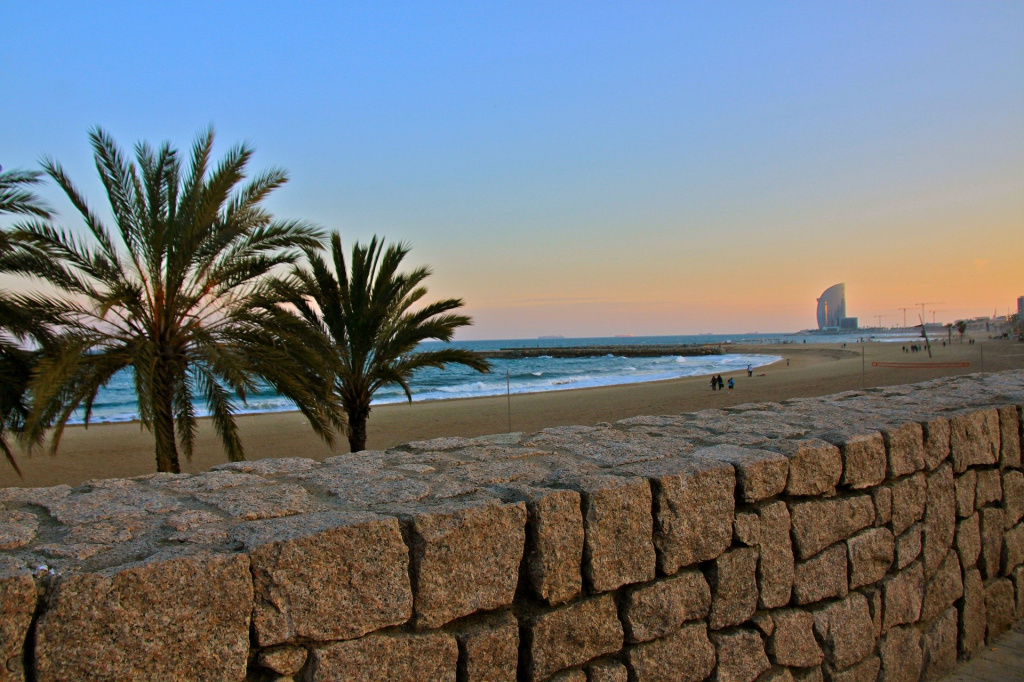
Some people say there are fewer people here than in Barceloneta, a place north of the city. It's also less crowded here. Surfing, windsurfing, diving, and snorkeling are all available. As in La Barceloneta, the beach is landscaped, has toilets, showers, and lifeguards. Despite the sandy surface, you probably won't want to take your kids. There's also a nudist beach.
Bogatell Beach is in Poblenou, which can generally be considered decent and business-minded. You can go here with kids, although most of the women prefer to sunbathe topless. Take the metro to Poblenou or Llacuna, then walk a bit. The beach has almost no vendors, but there are still lifeguards, showers, and police. The prices are cheaper than on Barceloneta, and there are tons of cafes and restaurants to choose from. Take the funicular up to Mount Montjuïc.
When people think of Barcelona, they usually think of the Rambla, where the dried-up river once flowed. There are 5 boulevards that cross the Old Town to get to the Gothic Quarter and the Boquería Market. The Royal Square in the Gothic Quarter is also worth a visit. The rest of the famous streets have a more modern look and don't always have a lot of green space. There are also some gorgeous buildings and monuments.
Ramblas are in the name-brand district, and the Liceu metro station is nearby. It's almost a legend how it was built: the street was built at the bottom of a dried-up river. The word «ramla» means «dry land». It's a pedestrian place now, it's too crowded on weekends. There are lots of shopping centers, monuments, and cafes to suit every taste.
Along this boulevard, you can walk to the Gothic Quarter and other attractions. About 1.2 kilometers of the Rambla cross the Old City. You can also get to the Boquería Market from here. All the green is plane trees.
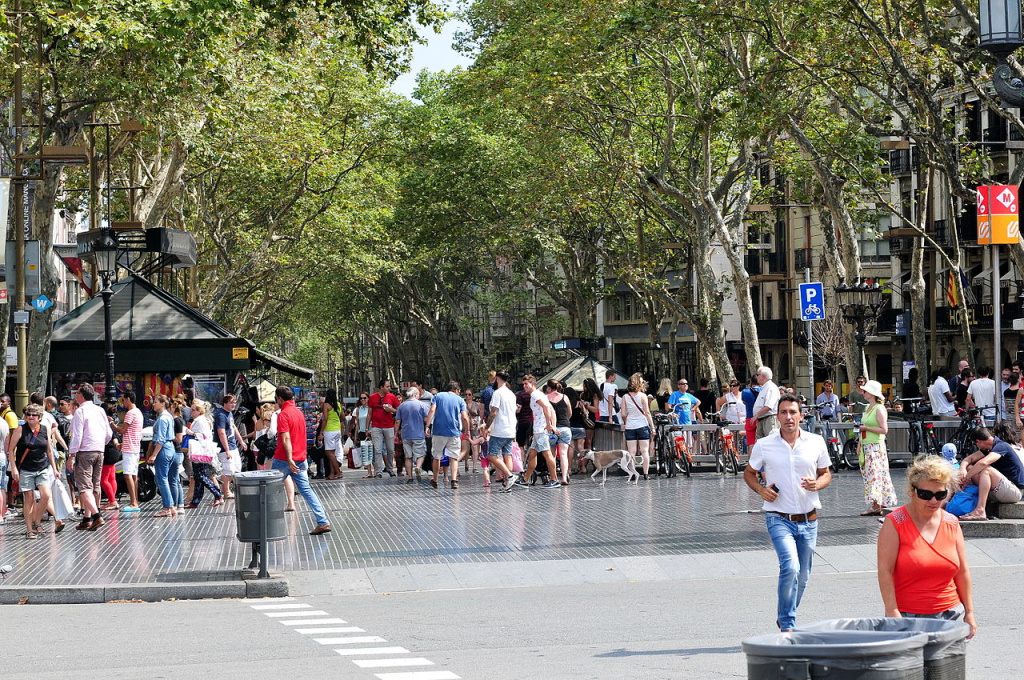
Photo: wikipedia.org
In the Sans Jojoic neighborhood, you'll find Plaça d'Espanya and the Espanya metro station. In 1929, two architects designed this square for the World Expo. Only the square of the same name in Madrid is bigger. A train station is underneath the square, and in the center of the circle is a monument and fountain.
On the edges of the square are the Fira Barcelona pavilions and the Venetian Gate. There are no tall trees to emphasize the architecture. Although it is especially charming at night, its proximity to the main roads does not make it an ideal place for quiet strolls.
This large green square is known as Plaza de Catalunya. The Eixample district is between the Gothic Quarter and the Sagrada Familia. Nearest metro is Catalunya. There's also a fountain, shops with designer clothes, cafes, and restaurants. Built in the mid-19th century, it connected the old and new city at the time. A major artery for transportation. Neoclassical.
Plaça Reial is a promenade in the Gothic Quarter. It has existed since the 19th century but before that, there was a wasteland of the burnt-out Capuchin monastery of Santa Madrona. The square was landscaped by two architects and the lanterns were designed by Gaudi. There are cafes and restaurants, but it is loved for its many festivals, including Mexican style.
Do not confuse King's Square with Plaça del Rei, both of which are in the Gothic Quarter. The square looks best by day and is surrounded by palm trees. You can easily get there on foot from Liceu station.

Photo: gidvbarcelone.com
Passeig de Gràcia is a wide green avenue in Barcelona's business district. It's off Plaza Catalunya. During the time when Gràcia was a suburb of Barcelona, the street was called Jesus' Way. This is where you'll find Gaudi's famous dragon house, Casa Batlló, and Casa Milo.
There's no better way to see Casa Batlló than by day and by night. There are two subway stations, Diagonal and Can Serra, that take you to the square. From fashion houses to a wine shop, there are plenty of cafes, restaurants, and shops here.
Barcelona has lots of garden sculptures, as well as monuments and statues. Visitors can see XIX century statues and modern art. It isn't a given that the new quarters will have modern art.
A statue of Christopher Columbus sits on the famous Ramblas in Barcelona. Back in 1888, it was opened to mark the end of the great navigator's journey. Following his geographic discovery, he went to the reception for King Ferdinand II and Queen Isabella I in Barcelona. This sculpture is by Rafael Arce.
The best part of the idea is the 57-meter elevator, which allows you to look out over the city. The statue is on top of a metal column. You can walk along the palm-lined avenue of Passeig del Colom.
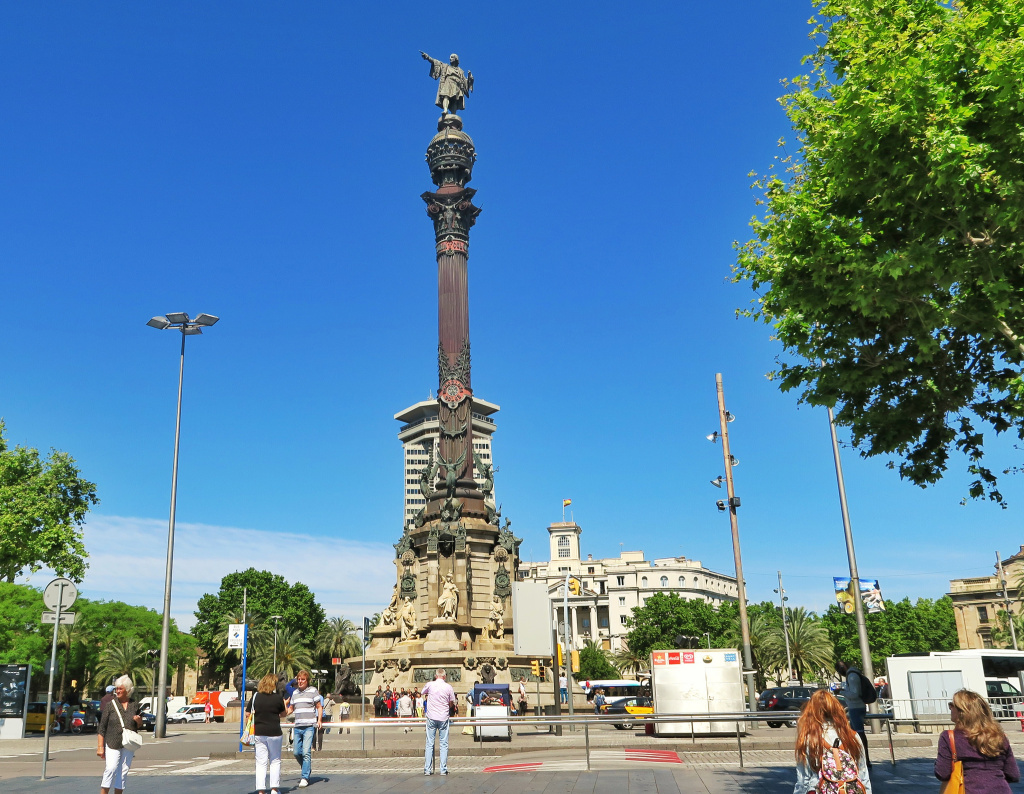
Photo: tonkosti.ru
There's an Arc de Triomf at the entrance to Citadel Park and a metro station by the same name. You can walk to the Gothic Quarter and the Old City from here. It's a red brick Neo-Mauritanian building with four towers arranged in pairs, so it's different from other triumphal arches. Josep Vilasecoy built it for the 1888 World's Fair. The structure is about 30 meters high. A few restaurants are nearby.
The first thing that comes to mind when it comes to parks is Gaudi's creation, Park Guell. As with every big city in Spain, Barcelona has a bunch of parks. Many of them have museums, galleries, and various pavilions. Some of them are free. You can sit on the grass in Barcelona's parks, but feeding the birds isn't recommended. Since the end of February, they're great for relaxing, so at least one of them is worth a visit. Take a look at the Citadel Park, Botanical Gardens, Labyrinth Horta Park, Tibado, and Montjuïc.
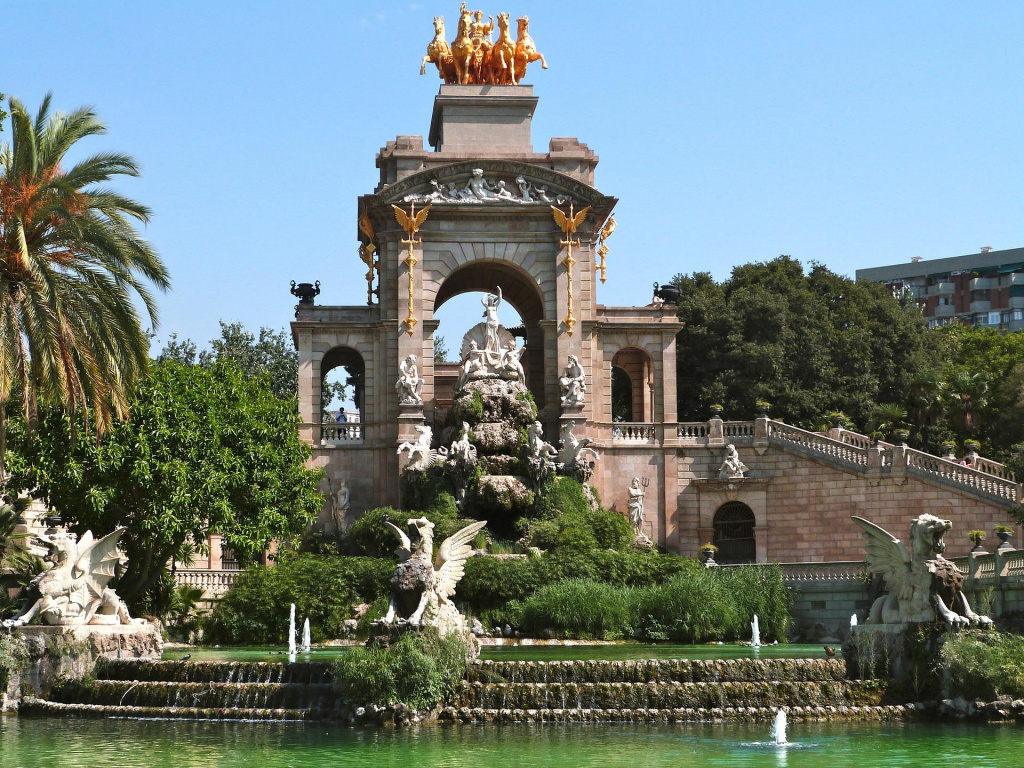
It sounds like Parc Ciutadella in Catalan. Located in the old part of town, it was open in the 19th century. The first official park in Barcelona. You can see the Catalan Parliament here, the zoo, and museums today. This park has a lake that will make it a nice place to stay during the summer.
There was a fortress once, and now there are three alleys: linden, elm, and poplar. In Ciutadella, there's a piece by Josepa Laimona called «Despair». Definitely worth checking out. Gaudi was among the architects who designed it.
The Park del Laberint d'Horta is in Horta-Guinardó. Even though Parc de la Citadella is Barcelona's oldest park, Labyrinth of Horta could challenge it. Because it's got a piece of Desvalles' garden from the eighteenth century. It got more green spaces in the Romanticism style in the nineteenth century.
The park became a public place in the 1970s and a few years later it was restored. Enjoy outdoor theater and the Desvalles Palace. The park has a canal, gazebos, topiaries, and lots of flowers. It has a strawberry tree, a rock oak, and an African lily.
Just walking around the center will not allow you to see the Botanical Garden. Make a route ahead of time and check the opening days to get here. You'll be glad you did. It's 14 hectares of paradise. Built in eight years, it opened in 1999.
Of course, there is a big artificial reservoir, there are wide paths, and there are drinking fountains. The garden's organizers want to collect about 4 000 Mediterranean plants here, but they're only letting in 1 500. Still, it's enough to learn about the local flora. Overhead you'll see birds, mostly parrots.
Additionally, plants from Chile, South Africa, Australia, and California are represented. A bonsai collection is also featured. Free guided tours are offered on weekends in Spanish. Come in early March when plants are blooming.
There is a good chance that Barcelona can compete with Madrid for the title of cultural capital, at least as far as the number of theaters is concerned. The city has a theater institute too. Institutions themselves can be majestic or they can be in caves or castles. Theatres include the Gran Teatre del Liceu, Tivoli Theatre, L'Auditori, National Theater of Catalonia, Barcelona Symphony Orchestra. Some interesting microtheaters include Palau Dalmases, Café Teatre Llantiol, Microteatre Barcelona, and others.
A memorable building, the Palau de la Música Catalana. Its horseshoe-shaped hall has stained glass windows and mosaic-covered columns. Everything about it is gorgeous, from the ceiling to the lights. It's Europe's first and only natural light theater, built in 1908. Lluce Domenech y Montaner, architect of the Catalan Art Nouveau. You can take a sightseeing tour or listen to Spanish guitar.
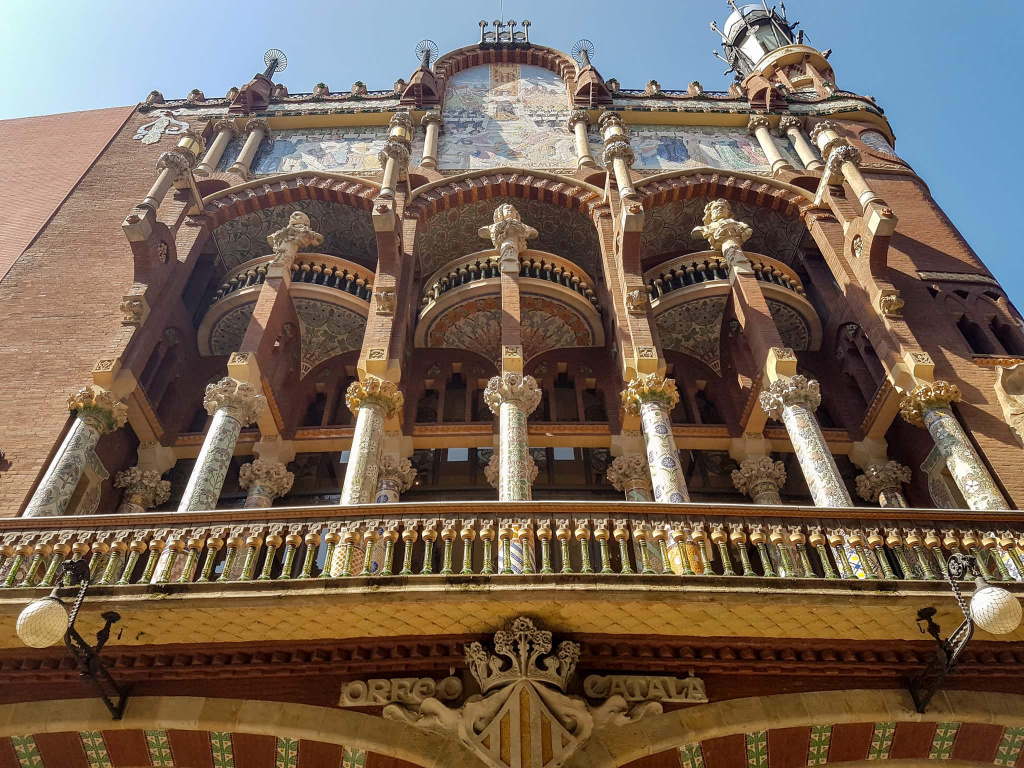
Photo: ispaniagid.ru
«The Liceo» opened back in 1847. But the interior and productions are a whole lot more modern than they were in the past. The theater is constantly plagued by fires and even a terrorist attack, so it's been heavily renovated and renovated. After La Scala, it's Europe's second biggest theater, and it once hosted Sergei Diaghilev's Russian ballet. There are subtitles in English, Spanish, and Catalan, and premieres usually attract guests from all over.